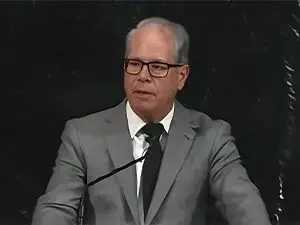
Governor Mike Braun delivered his 2026 State of the State address Wednesday evening, declaring Indiana’s economy strong and outlining his administration’s focus on affordability for Hoosier families.
“The state of our state is strong,” Braun told lawmakers and guests assembled for the annual address. He cited Indiana’s GDP growth, which he said is outpacing neighboring states and the national average.
Economic Growth and Job Creation
The governor highlighted job creation efforts, noting that the state now spends an average of fifteen thousand dollars per new job, down from forty-six thousand dollars two years ago. Average wages for those positions have increased by seventy-five hundred dollars annually, he said.
Braun pointed to several major economic development projects across the state, including Amazon’s fifteen billion dollar data center in northwest Indiana, Caterpillar’s manufacturing expansion in Lafayette, and hundreds of jobs being created by companies in Fishers, Kosciusko County, and Crane.
The governor also mentioned ongoing efforts to bring the Chicago Bears to Indiana.
Addressing Utility Rates and Data Centers
Utility costs emerged as a key theme in the address. Braun announced the appointment of Abby Gray as the state’s consumer advocate, praising her recommendation for a rate decrease in response to the first rate increase request she reviewed.
On data centers, the governor said companies seeking large amounts of power should pay their own way. He cited Amazon’s commitment to cover its power needs as a model, stating that if other companies follow suit, “Hoosiers’ electricity rates won’t go up, they’ll go down.”
Property Tax and Housing
Braun touted what he called historic property tax reform that will save taxpayers one point five billion dollars over three years. He also backed legislation aimed at reducing regulatory barriers to homebuilding to address housing affordability.
Healthcare and Government Spending
The governor addressed healthcare costs, pointing to transparency and accountability measures passed last session. He supported new legislation aimed at protecting Hoosiers from medical debt.
Braun said his administration has tightened spending, with most state agencies operating with ten percent budget cuts. He highlighted efforts to combat Medicaid fraud, claiming four hundred sixty-five million dollars in savings this year.
The governor also announced that every public university in Indiana has frozen tuition and mandatory fees for the next two years.
Education and Social Policy
Braun emphasized parental control in education, celebrating the implementation of universal school choice and increases in teacher starting salaries. He backed legislation to limit cellphone use in schools and give parents veto power over their children’s social media use.
The governor also discussed plans to invest in making childcare more affordable and available.
Public Safety
Indiana State Police efforts to combat drug trafficking received significant attention. Braun said troopers seized over thirteen hundred pounds of cocaine in bulk shipments last year, along with eighty-four pounds of heroin and fentanyl. He credited these efforts with contributing to a sixty percent drop in overdose deaths.
The governor backed constitutional amendments to allow preventive detention for violent criminals and legislation to strengthen penalties for child predators.
Democratic Response
Senate Assistant Minority Leader Shelli Yoder issued a statement following the address, commending budget commitments to education and public health but arguing the budget falls short in key areas.
“This budget still fails to make the massive investment we need in pre-K and childcare, leaves already-vulnerable Hoosiers burdened by regressive tax structures, and does not truly reckon with the root causes of Indiana’s brain drain and workforce issues,” Yoder said.
She noted that while investments in businesses are important, “a great state starts with investments in citizens” including affordable housing, childcare, and clean air and water.
Yoder also criticized what she called “harsh social policies” signed into law over the past year, saying such policies drive young workers away from Indiana. However, she expressed hope that the legislature would “steer clear of culture wars this session and really get to work for Hoosiers.”
The address comes as the Indiana General Assembly continues its 2026 legislative session.
=====
In 2025 our message was clear: Indiana is open for business.
Indiana’s real GDP is growing faster than the national rate.
We’re growing double the rate of Illinois.
Double the rate of Ohio
Triple the rate of Kentucky
And growing 6 times faster than Michigan.
The time is now, and the place is Indiana, and the state of our state is STRONG!
Affordability is our highest priority.
The last D.C. administration unleashed inflation that’s still making it hard for families to get by.
I’ve spent my life as a job creator. I know the most important part of affordability is new jobs and higher wages.
Average hourly earnings for Hoosiers rose over 4 percent last year. And wages in Indiana are growing faster than the national average.
Two years ago we spent an average of $46,000 dollars to bring a job to Indiana.
Now we’re spending a fraction of that: only $15,000 dollars per new job.
And the average wage for those jobs is up 10 percent, an increase of $7,500 dollars a year.
Utility rates are too high.
That’s why I appointed a new advocate for Hoosiers to hold the line on utility price hikes.
Abby Gray, the state’s official consumer advocate, is with us this evening.
The first time a request came to her asking for a rate increase, she responded with a recommendation for a DECREASE.
That’s what I like to see.
Abby, thank you for partnering with me to protect Hoosiers from utility rate hikes that don’t make sense.
Affordability is why I support Rep. Alaina Shonkwiler’s bill to hold investor-owned utility companies accountable to provide affordable energy before they can increase their profit margin.
And it’s why I appointed three rate-payer conscious members, now constituting a majority, to the Indiana Utility Regulatory Commission — to make decisions in the PUBLIC INTEREST to ensure utilities provide service at just and reasonable rates.
Let’s talk about data centers.
Hoosiers are concerned about their electricity rates going up to pay for them.
AI is going to be key to the jobs of the future, but data centers can’t stick Hoosiers with the power bill.
Companies that want big power in Indiana should pay their own way.
For example, Amazon is building a $15 billion dollar data center in northwest Indiana. They’re going to pay for every cent of their new power needs, and then some.
If other companies will follow this model, we’ll lead the country in the AI race and Hoosiers’ electricity rates won’t go up – they’ll go down.
Another weight on Hoosiers’ wallets when I took office was property taxes.
It’s a major driver of the affordability crisis.
That’s why I led the way to historic, meaningful property tax reform.
Our historic property tax cut will save taxpayers $1.5 billion dollars over the next 3 years.
It ensures local governments have resources for essential services, and Hoosier homeowners can keep more of their money in their pocket.
But there are too many Hoosiers who can’t afford to own a home at all.
Home prices have surged because we aren’t building enough, and unnecessary regulations are driving up costs.
Rep. Doug Miller has a bill that will get government out of the way and make it easier for Hoosiers chasing the American dream to buy their own home.
I support it 100%.
Health care is too expensive.
As a business owner, I know how important it is to provide employees with high quality health care at an affordable price.
I built a health care plan in my company that hasn’t had a premium increase in 18 years, based on the principles I’m putting to work in the state of Indiana: wellness and prevention, not expensive remediation.
Last session, we took major steps to put patients in charge of their health care and cut prices through transparency and accountability.
This year, Sen. Justin Busch, Rep. Martin Carbaugh and Rep. Julie McGuire have proposed pieces of legislation that will keep Hoosiers out of crushing medical debt.
We need creative solutions to make health care affordable and protect families from predatory collections.
You know what else makes life more affordable? The government spending less of your money.
We tightened our belts with the budget this year, with the majority of Indiana’s state agencies operating with 10% cuts.
The projected budget shortfall last year has been neutralized, and next year’s revenue forecast shows strong growth across the board.
We’ve cracked down on waste, fraud, and abuse, and our efforts have received national attention.
While some states are in the news for billions in Medicare and Medicaid fraud, Indiana has found $465 million dollars in savings — just this year.
Indiana is making Medicaid responsible and sustainable for those who need it most.
For Medicaid recipients who can work, work requirements foster self-sufficiency and build a foundation for a better life.
I want to thank Senator Chris Garten for Senate Bill 1 which codifies several of the actions we’ve taken already and positions us to lead the nation.
We’re continuing to deliver high-quality essential services that Hoosiers rely on, while you keep more of your money — because it’s not ours, it’s yours.
When something was broken, we didn’t wait for permission — we fixed it.
I looked at what former Governor Daniels did at Purdue by freezing tuition, and asked “Why can’t they all do that?”
Now, every public university in the state of Indiana has frozen tuition and mandatory fees for the next two years.
I took action on common sense matters like protecting girls’ sports.
And I took action to ensure food stamps are used for their intended purpose: real food, not junk food.
And we’re getting better results from education.
After decades of trying to get it done, Indiana now has UNIVERSAL SCHOOL CHOICE.
This fall, every Hoosier parent will have the opportunity to choose the school that best fits their child’s needs.
Last year’s budget had some hard decisions, but the first thing we did was fully fund K through 12 education.
More money is making its way to teachers and classrooms and less to administrative buildings.
We raised starting teacher salaries by $5,000 dollars so we can recruit the best.
We’re hitting all time records on literacy scores and graduation rates.
Everything we did was based around one simple principle: Parents are in charge of their kids’ education.
I support Sen. Jeff Raatz’s bill to limit cellphone use in schools and give parents veto power over their kids and social media.
That’s a decision for you to make as parents, not Big Tech.
I want to thank Dr. Katie Jenner for your leadership in improving education for Hoosier kids.
Recently I’ve had a new advisor on education policy.
A 9 year old named Jack Gibson from down in Shoals.
He asked me if I could delay school on Tuesday morning so he can stay up late and watch the Hoosiers win on Monday.
I like the sound of that.
I’ll leave it up to each school district to decide, but I think that sounds like a good idea.
I want to thank my new advisor Jack for a great idea. Go Hoosiers!
If we’re going to grow our economy and help Hoosiers get better jobs, we need to make child care more affordable and available.
That’s why I look forward to digging in during the budget session on what we can do to invest in lowering child care costs.
I would like to see a program where businesses have some skin in the game to make child care more affordable.
Indiana is the best place in America to create jobs.
And we’re making sure these jobs benefit all four corners of the state.
I’ve been all over the state breaking ground on new projects creating thousands of new high wage jobs.
INCOG BioPharma is creating 792 jobs in Fishers.
Autocam Medical Devices is adding 300 jobs in Kosciusko County.
Kratos Defense is creating 628 high wage jobs in Crane.
Caterpillar is making their biggest manufacturing expansion in company history in Lafayette.
And I already mentioned Amazon’s 1,100 new jobs in the Region.
Project after project, industry after industry, the story is the same: Indiana is the Midwest’s growth engine for more jobs and bigger paychecks.
And while we’re on the subject of businesses coming to the Region —
US Steel is growing. The Whiting Refinery is expanding.
And with our strong business environment, it’s not surprising that another organization has noticed that Indiana is open for business: the Chicago Bears.
We are working hard to bring the Chicago Bears to the Hoosier State.
We are investing in Hoosier workers.
Tonight in the audience we have Lonnie Camp, a paramedic with Tri County Ambulance Services.
Lonnie upskilled through the program and his hourly wage is now 25% higher than it was a year ago.
Lonnie, congratulations to you for growing your professional skills while growing your paycheck.
Tonight’s been all about affordability, but I want to take a moment to recognize the incredible work of the Indiana State Police last year.
When I took office, I asked Indiana State Police Superintendent Anthony Scott to crack down on drug trafficking on our highways.
The Indiana State Police launched a full-scale program to stop narcotics before they make it to our communities.
They seized over 1,300 pounds of cocaine from bulk shipments in 2025.
Troopers also seized 84 pounds of heroin and fentanyl, DOUBLE what they took off the street the year prior.
And just last week, Indiana State Police seized over 300 pounds of cocaine in one traffic stop, with an estimated street value of $7 million dollars.
These efforts saved lives. Overdose deaths dropped over 60%, from 1,610 in 2024 to 562 last year. That’s hundreds of Hoosier lives saved.
Last year, we increased penalties on repeat violent criminals and drug dealers.
We have to make sure that when the most violent criminals are arrested, they aren’t just turned back out on the streets.
That’s why I support bills by Senator Eric Koch and Senator Aaron Freeman to amend our constitution to allow for preventive detention.
Hoosiers are compassionate people; we feel for those who are dealing with homelessness.
But we also must set clear expectations for the use of public spaces.
And I support local solutions that will help those individuals and keep Hoosier families safe in our cities.
Last year, State Police also launched Operation Guardian Angel to save children from abuse, resulting in 48 arrests already.
I support Rep. Wendy McNamara’s bill to help our State Police put more child predators behind bars.
I want to say Thank You to every law enforcement officer in the state for your work protecting Hoosiers. We will ALWAYS Back the Blue.
And I want to thank Major General Larry Muennich and the Indiana National Guard for all they do to serve our state and our nation. Thank you.
I’m so proud of the work we’ve done to make Indiana a better, more affordable place to build a life.
My administration has people from up and down the state. We have Butler fans, Notre Dame fans, Purdue fans…
But on Monday I expect to see all of them wearing cream and crimson!
Go Hoosiers!
On and off the football field, Indiana is winning big.
We have secured big wins already to make life more affordable for Hoosier workers, and there’s much more to do.
Together, we can make Indiana the state where your dollar goes further, where opportunity abounds for all who are willing to work hard, and where every Hoosier worker can build the life they deserve.
Thank you, and God Bless the Great State of Indiana.